
Our Mission:
is to create a loving and helpful community by showing and sharing God’s love
Our Vision:
- is to make St Michael & All Angels a welcoming place for all members of the community who
are seeking to worship God and share in his work.
- We want to keep God’s ministry alive in our
community.
You are welcome to join us at any of our services
or at any of the other Parish Churches in our benefice:-
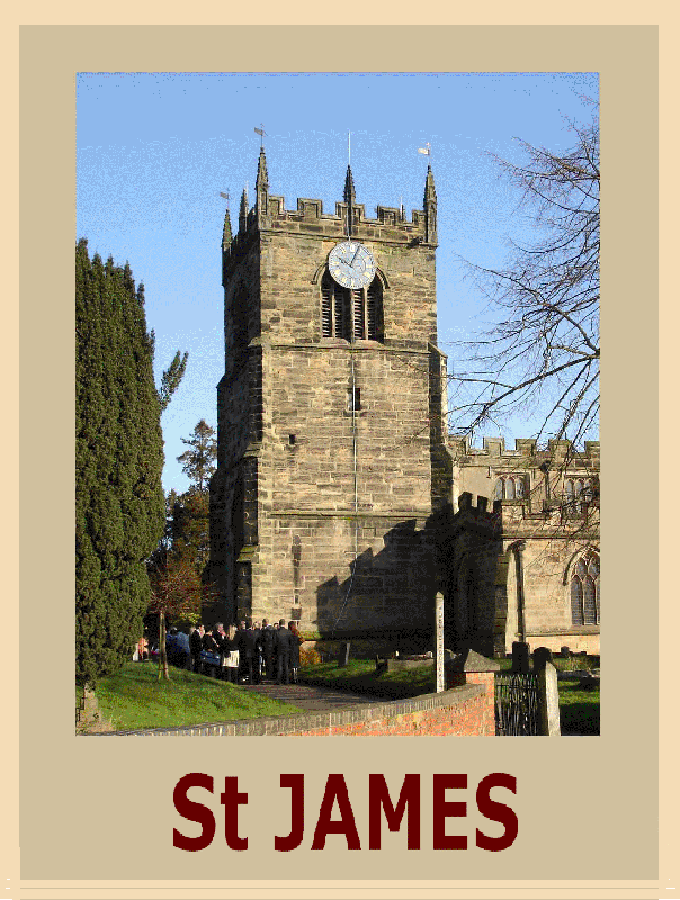
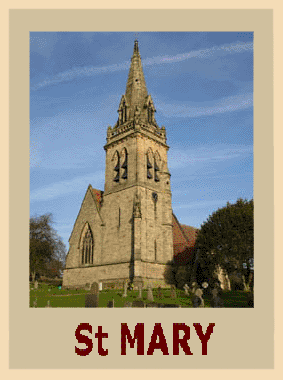
St Mary, Dunstall and St James, Barton-under-Needwood
Our Church is in the centre of the village and along with the Village Hall we would like it to be the heart of
the community - being pro-active as well as being there when needed.
The churchyard is still open.
The congregation has a deep affection for the church and its community and an active commitment to its continuation and prosperity. We endeavour to demonstrate the Christian message through our support of charities both locally and further afield.
Sunday Services:
Holy Communion with Hymns at 9 am
on the 2nd and 4th Sundays of the month.
On other Sundays we share in the service at Dunstall.
Contacts:
Vicar: Rev'd Andrew Ridley Tel: 01283 712359 Click here to email Andrew
Churchwardens:
Phil Coleman
Tel: 538983
Jane Bristow
Tel: 542933
About our Church
Tatenhill is an ancient settlement that is first mentioned in a grant of lands by King Edmund in 941 AD.
The earliest evidence of Christianity in this place is a wheel headed cross now sadly no longer in the parish, having been removed to nearly Rolleston-on-Dove in the 19th century. This cross is of the 9th century and of Danish inspiration, presumably a result of the Viking incursions during the 9th century. It can still be seen in Rolleston churchyard, to the west of the tower.
Tatenhill church was originally the mother church to a wide area, with chapelries in Barton-under-Needwood, Dunstall, Wychnor and Newbold (now vanished).
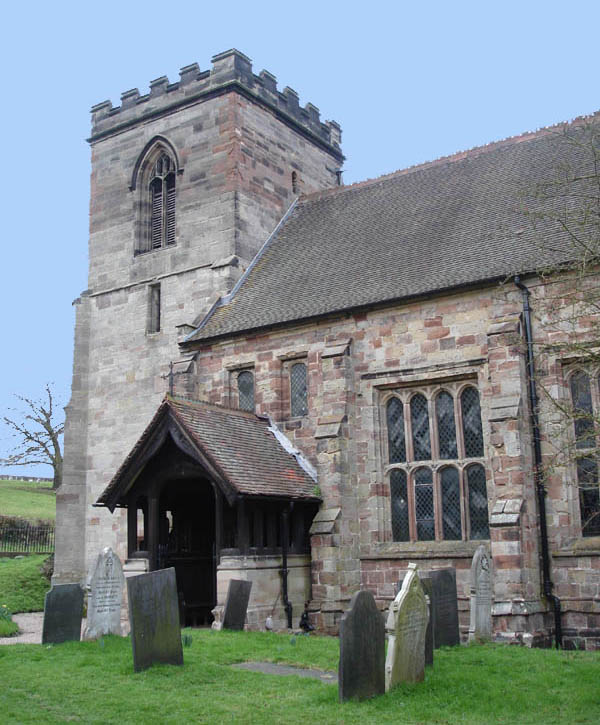
The present church consists of a short embattled west tower, nave with a south porch and a chancel. The church is remarkably spacious considering that it does not have any aisles.
The bulk of the building dates from the 13th century and is built of soft red sandstone. Externally only the south and north doorways of the nave give away the true date of the building. The other original features of the church include the 13th century font and the trefoil-headed Sedilia and Piscina in the chancel.
The exterior impression of the church is that of the late Middle Ages. This is the result of work carried out on the church during the 15th and 16th centuries. The three bay chancel, although having some 13th century masonry, is largely of the 15th century and the four-light north and south windows are of this date.
Above the pulpit is a small piece of preserved Medieval wall painting. The interior of the church, like all medieval churches, would have been decorated with images of heaven and hell to focus the mind of the worshippers.
The short embattled west tower was built at the same time that the nave windows were replaced with large straight-headed mullioned and transomed four-light windows with arched lights. This style is typical of the Tudor period.
In the chancel is an alabaster wall monument to the wife (died 1641) and two daughters of Henry Griffiths. This monument is possibly a late example of the work of the alabaster workshops of nearby Burton-upon-Trent, which were famous for their alabaster monuments in the late 15th and 16th centuries.
The Victorians also left their mark upon the church, the main piece being the large east window of Perpendicular style. The glass in this window is of 1882 by Ward & Hughes.
The church was restored in 1890 by noted Victorian architect George Frederick Bodley. He added the timber porch, as well as the stalls, reredos and black and white marble flooring in the chancel.
At the end of the 16th century the vicar of Tatenhill was a noted European theologian and scholar, with links to many of the key figures of the day. Adrian Saravia (1531-1613) was born in Hesdin, Artois in the Spanish Netherlands. As a young man he had been a Franciscan Friar, but converted to the Calvanist cause by 1557.
In 1568, as tensions grew in The Netherlands and across Europe as a result of religious turmoil, Saravia (who had been working at a school in Guernsey) left to become the chaplain to the Army of William, Prince of Orange. In 1584 he was appointed lecturer of theology at the recently founded Leiden University.
In 1587 Saravia was implicated, along with others, as plotting against the authorities in Leiden, and was summoned to face trial. He failed to present himself for trial and a warrant was issued for his arrest. Saravia travelled secretly to England where he arrived in December 1587. Adrian Saravia became the rector of Tatenhill (including Barton-under-Needwood and Dunstall) in Janaury 1588 and remained here until November 1595, when he became vicar of Lewisham. On 6th December 1595 he was installed as a Canon of Canterbury Cathedral and in 1601 he also became a Canon of Westminster Abbey.
One thing that Adrian Saravia did for the local area was the building of a school in Barton-under-Needwood, at the request of Thomas Russell, a Draper of the City of London. Adrian Saravia died on 15th January 1613 in Canterbury and was buried in the Cathedral. His memorial plaque can still be seen near to the north-west door of the nave.
Parish records for St Michael and All Angels, Tatenhill
Historic records of St Michael and All Angels, Tatenhill have been deposited at Staffordshire Record Office, where they are available for consultation by the public. These include the parish registers of baptisms 1563-1920, marriages 1563-1994 and burials 1563-1878; churchwardens accounts 1815-1936; vestry minutes 1834-1961; tithe awards and maps for Tatenhill and Callingwood, and Highlands Park, 1839; and much more.A catalogue of these records is available in:
"Gateway to the Past" (http://www.archives.staffordshire.gov.uk) - the online catalogue of the Staffordshire and Stoke on Trent Archive Service. The Archive Service's website (http://www.staffordshire.gov.uk/archives) provides further information on planning a visit to the office to consult records, should you wish to do so.